

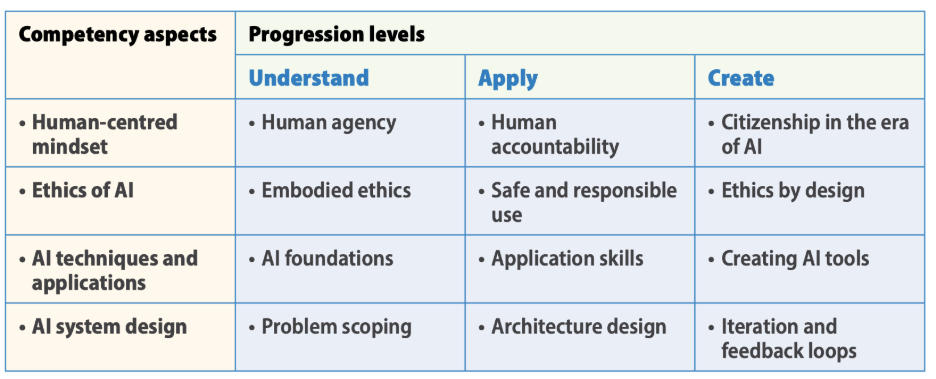
UNESCO’s AI Competency Framework for Students (2024) is an international reference that sets out the importance of integrating AI learning objectives into school curricula and how crucial it is for students to engage with AI safely and meaningfully. This framework aims to help educators in this integration, outlining 12 competencies across four dimensions:
- Human-centred mindset
- Ethics of AI
- AI techniques and applications and
- AI system design.
Each of these competencies span across three progression levels: Understanding, Applying and Creating with AI. The framework also includes guidance on curriculum design, learning outcomes, teaching methods and learning environments so that leaders can build AI into schooling in a coherent way.
The UNESCO AI competency framework for students p.19
The framework offers a common, UNESCO approved basis for AI education that is not tied to any tool or company. It keeps the focus on human rights, ethics, sustainability and inclusion and aims to support students to become responsible users and active co-creators of AI, rather than passive consumers.
How school leaders can use it
School leaders can use the framework as a planning tool when updating their digital learning plans, curriculum and AI-related policies. It can help them decide which aspects of AI to prioritise based on their school’s context and to ensure that AI initiatives support broader student competencies rather than narrow AI tool usage skills. For example, a school might consider ‘Ethics’ and the ‘Safe and ethical use’ of AI by students and use this framework for guidance.
How teachers can use it
Teachers can use the framework to map AI-related learning to existing subjects and learning contexts such as maths, science, SPHE, CSPE, literacy, languages and the arts.
The progression levels can support teachers to set age-appropriate learning intentions and developing students’ understanding of what AI is and how it affects their lives. It also offers more advanced opportunities for interested students to apply AI tools or explore AI system design. The detailed competency blocks, (refer to table above), suggested pedagogies and sample learning exemplars can be adapted into lessons, projects and assessment tasks that connect AI concepts with real-life issues.
Practical implications
Using the framework, a post-primary school might consider how students could explore “human agency” and “human accountability” in the era of AI through case studies, debates and personal reflection tasks. In another example, teachers could introduce “AI foundations” by examining everyday AI tools, discussing how data and algorithms work, and running unplugged or low-tech activities before moving to simple, age-appropriate programming tasks. For older or more interested students, the “Create” level can guide project-based work where they adapt existing AI toolkits for a specific purpose, while continually checking for fairness, privacy and environmental impact.
Integrate AI learning into existing curriculum areas and your school DL plan, instead of creating a separate policy. Plan for equity by considering access to devices, connectivity and open or low-cost tools, and by paying particular attention to learners with disabilities and those from minority language or cultural groups. Invest in teacher professional learning so that staff understand both the technical basics and the ethical dimensions of AI and use the framework’s guidance on pedagogy and environments to blend offline activities, discussion and critical reflection with any use of digital tools.