

Released 22nd October, 2025, the purpose of this guidance is to support school leaders and teachers to develop an understanding and knowledge of relevant considerations regarding the use of AI in teaching and learning and school leadership.
What is AI?
“Artificial Intelligence (AI) refers to the development of computer systems that can perform tasks that typically require human intelligence. It involves creating algorithms – a list of rules or steps – that are used by computers to analyse, understand, and respond to information.
While AI systems can process and analyse large amounts of data to recognise patterns and make predictions, they are not able to think and understand context like humans can.“
(Definition: Webwise AI and Online Safety page)
Watch our video What is AI?
Generative AI
Generative AI or GenAI is a relatively new type of AI. It can generate new content in the form of text, images and videos. The content is generated based on a query or a prompt that is entered into the GenAI tool. Examples of GenAI tools are ChatGPT from OpenAI, Microsoft CoPilot, Google Gemini and Anthropic’s Claude.
Watch our video What is GenAI?
Exploring AI for your school – the 4P Approach
Just like with any new technology, deciding on whether and how to use AI starts with your overall goals as a school.
The Guidance on Artificial Intelligence in Schools document recommends the 4P Approach.
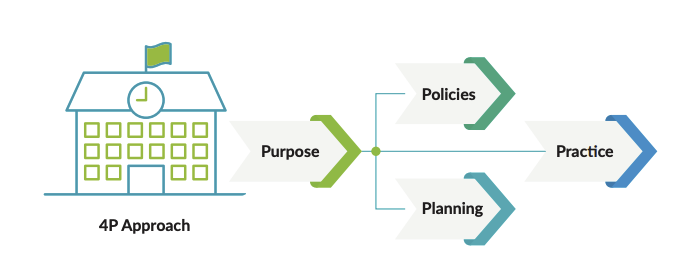
Purpose: Establishing a clear purpose for using AI.
Planning: Ensuring that the use of AI aligns with existing school plans, such as the digital learning plan and school improvement plan.
Policies: Reviewing existing policies to ensure responsible and effective implementation of AI.
Practice: Setting expectations for the practical use of AI to optimise learning while ensuring alignment with the curriculum, safeguarding student wellbeing and maintaining the central role of the teacher.
Guiding Questions
We’ve compiled some questions and considerations, aligned with SSE and the DL planning process below.
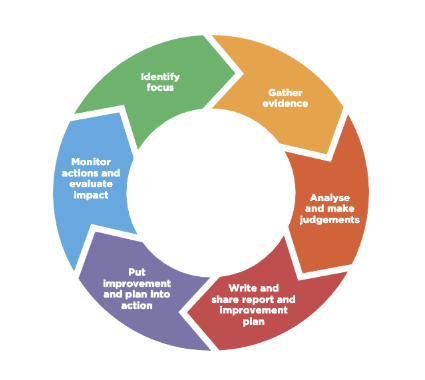
- Why AI?
- SSE and DL Plan focus
- Staff Readiness
- Set a target
- Safe and ethical use
- Action planning
- Monitoring actions
Why AI?
- Have you seen AI improve learning in your own school or elsewhere?
- Are there current challenges you think AI could help solve?
- Talk to your colleagues about why you might want to start exploring AI. Watch some good practice videos to see how other schools are getting started with AI.
What is your SSE and DL Plan focus?
- Could AI support your School Self-Evaluation (SSE) goals?
- Does the use of AI support your Digital Learning Planning goals?
- Identify one or two areas you are already focussing on (e.g. inclusive practice, assessment) where AI could have an impact.
Staff readiness
- Are there staff already exploring and using AI in the classroom?
- Is there a need for upskilling?
- Survey staff needs in relation to AI. Share existing courses such as the Oide Technology in Education online course on AI with colleagues.
Set a target
- With SSE and your DL Plan in mind, what is your target?
- Define an appropriate target, which is both tangible and achievable to get started.
Safe and ethical use
- Does your Acceptable Use Policy (AUP) support the ethical and safe use of AI?
- What tools do you plan to use and how will you evaluate them? View our 5 Considerations for AI use.
- What are the age restrictions on the tools (some AI tools are not permitted for under 13s)?
- Review your current AUP and update it using the Webwise AUP Generator tool.
Make an action plan
- What steps will you take to explore AI use?
- What supports can your school avail of?
- Use the DL action planning template to plan your next steps. Tap into AI supports offered by Oide Technology in Education and others.
Monitor actions
- What is working well and what needs adjusting?
- Ask if and how AI is supporting your school’s SSE goals.
- Continually monitor progress and share and celebrate successes. Update your Digital Learning plan as required.
Important references when considering the use of AI.
Department of Education and Youth Guidance on Artificial Intelligence in Schools