

The UNESCO AI Competency Framework for Teachers (2024) aims to define the knowledge, skills and values teachers require in this ever-changing landscape.
In education, AI has transformed the traditional teacher-student relationship into a teacher-AI-student dynamic. This shift requires a re-examination of teachers’ roles and the competencies they need in the AI era.
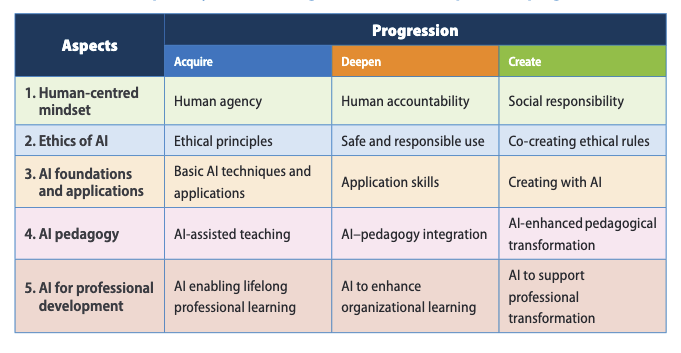
The Framework outlines competencies grouped across five areas which include:
1. Human-Centered Mindset
2. Ethics of AI
3. AI Foundations and Applications
4. AI Pedagogy
5. AI for professional development.
It provides a common language for what teachers should know and be able to do, to use AI safely, effectively, and inclusively.
The AI competency framework high-level structure: aspects and progression levels p.22
Relevance to Schools
For schools, the framework helps align classroom practice with whole-school policy, safeguarding, and professional development. It clarifies expectations for staff, supports equitable, UDL-aligned approaches and offers a reference point when selecting resources, planning CPD or communicating with parents.
How school leaders can use it
Set a baseline and goals: Map your current staff capabilities to the 15 competencies and identify priority gaps e.g., ethics and data protection; AI-enhanced assessment.
Plan AI Professional Learning: Sequence learning from awareness of usage cases, implementation into practice, evaluation and evidence of impact and linking to your school self-evaluation processes.
Inform policy and procurement: Use the competencies to inform acceptable-use guidance, risk assessments and AI vendor considerations (e.g., transparency, accessibility, data handling).
Embed inclusion: Ensure competencies translate into accessible classroom practices (assistive technology, language supports, multiple means of engagement and expression).
How teachers can use it
Lesson design: Use AI to augment, not replace, core pedagogy—planning, differentiation, feedback, and formative assessment—with explicit checks for accuracy and bias.
Classroom routines: Teach students to question AI outputs, cite sources, and protect privacy; model ethical use and human oversight.
Professional Self-reflection: Select 1-2 competencies as annual development goals (e.g. prompt design and evaluation; bias awareness; designing AI-supported tasks).
Practical examples
Planning & differentiation: Use AI systems to suggest task variants at different readiness levels, then review for accuracy, bias, and accessibility before use.
Feedback & assessment: Generate draft success criteria or exemplars, adapt to plain language and co-create with students, verify any AI-produced feedback.
Language & inclusion: Produce scaffolded instructions (visuals, simplified text, translated summaries) for EAL learners, confirm correctness and cultural appropriateness.
Professional learning: Run a short, peer-led workshop where teachers bring a lesson, apply one competency (e.g., ethical considerations) and record adjustments needed.